
Introduction
Choosing between a stepper motor and a servo motor is a common decision in motion control design. Both are used for positioning and speed control, but they behave differently under load, at higher speeds, and in more demanding motion profiles. In this article, we’ll delve into the differences between stepper motors and servo motors to help you make an informed decision.
What are Stepper and Servo Motors?
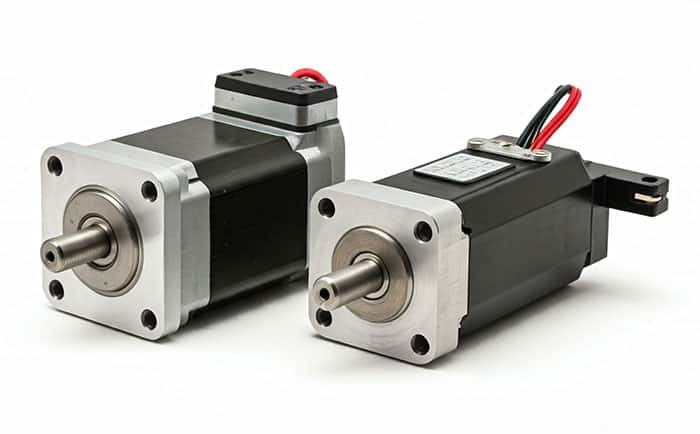
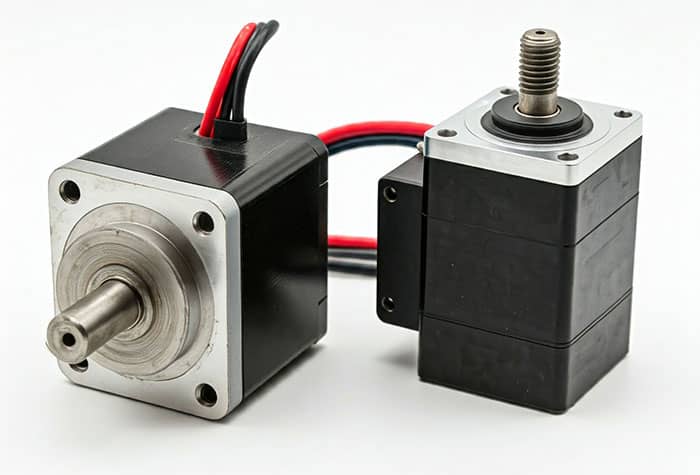
- Stepper Motor: A stepper motor is an electrical device that converts digital pulses into mechanical displacement. It rotates in discrete steps, making it ideal for applications requiring precise positioning.
- Servo Motor: A servo motor is a closed-loop control system that uses feedback to control its position, speed, and acceleration. It provides more precise and dynamic control compared to stepper motors.
Key Differences Between Stepper and Servo Motors
| Feature | Stepper Motor | Servo Motor |
|---|---|---|
| Control | Open-loop | Closed-loop |
| Precision | Lower, prone to losing steps | Higher, precise positioning |
| Speed | Lower, slower acceleration | Higher, faster acceleration |
| Torque | High torque at low speeds, decreases at higher speeds | Constant torque or power output |
| Applications | Open-loop control, less demanding positioning | High-precision positioning, speed control, motion control |
| Cost | Lower | Higher |
Advantages and Disadvantages
- Stepper Motors
- Advantages: Simple, low-cost, easy to control.
- Disadvantages: Lower precision, prone to losing steps, slower speed, noisy.
- Servo Motors
- Advantages: High precision, fast response, flexible control, reliable performance.
- Disadvantages: Higher cost, more complex system.
Application Scenarios
- Stepper Motors: Commonly used in printers, CNC machines, packaging machines, and other applications with lower precision and speed requirements.
- Servo Motors: Widely used in robotics, CNC machines, automation production lines, and other applications demanding high precision and speed.
How to Choose Between Stepper and Servo Motors
- Precision: For high precision, choose a servo motor. For lower precision, a stepper motor might suffice.
- Speed: If high speed and acceleration are required, a servo motor is a better choice.
- Cost: If cost is a primary concern, a stepper motor might be more affordable.
Conclusion
Stepper motors and servo motors are both useful motion-control solutions, but they are optimized for different kinds of work.
Stepper systems are often attractive for simpler, lower-speed positioning tasks where cost and control simplicity matter. Servo systems are usually the better choice when the application demands higher speed, stronger dynamic response, or closed-loop correction under changing load conditions.
The best comparison is not theoretical. It comes from the actual application: speed, torque, load behavior, accuracy target, and system architecture.